Translational Research Integration & Support
Bring together expertise from cancer research institutes and academic centres across Singapore through a comprehensive facilitative pipeline for translational and pre-clinical research.
Last updated 14 July 2026
The Translational Research Integration and Support platform delivers end-to-end solutions for multi-institutional translational and pre-clinical studies — from study design through to outcomes. We bring together expertise from cancer research institutes and academic centres across Singapore to develop, test, and validate novel biomarkers and molecular diagnostics.
Our platform offers a comprehensive facilitation pipeline for translational and pre-clinical research, and serves as a coordinating hub for molecular assays and ex vivo tumour models. Through this integrated approach, we support collaboration and strengthen cohesion across academia and industry within the cancer research ecosystem.
Translational and Pre-clinical Research Pipeline
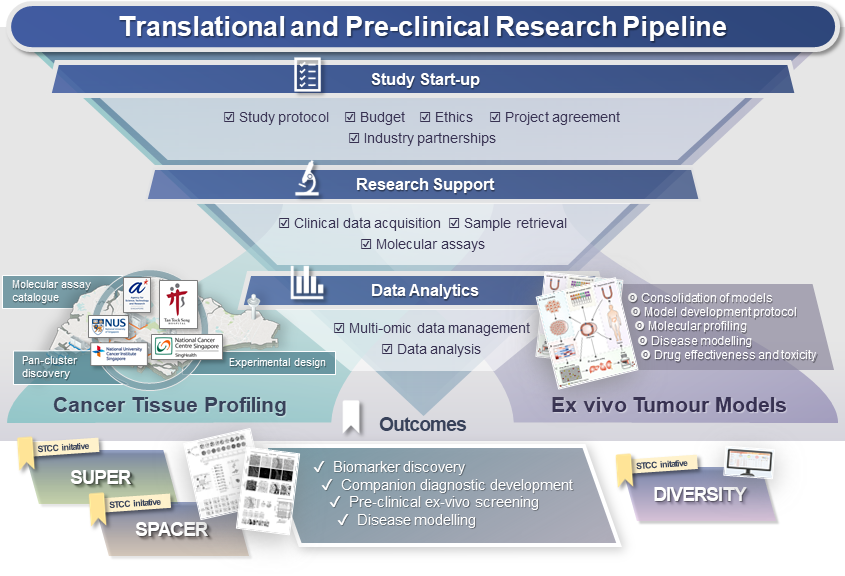
A versatile end-to-end pipeline that enables and accelerates multi-partner translational and pre-clinical studies, with STCC serving as the central point of contact. We deliver streamlined workflows that integrate capabilities across multiple local institutions to support every stage of the research process—from study initiation (including study design, protocol development, budget preparation, and ethics and multi-party agreements), to case selection and sample acquisition, multi-omic molecular profiling at partner institutes, compound screening, and data analytics and management.
Key focus
Cancer Tissue Profiling
Coordinating hub for non-interventional clinical studies and downstream translational research linked to clinical trials. We support every stage — from cohort identification and tissue retrieval to multi-omics profiling and data management.
Capabilities include: Whole Exome/Genome Sequencing (WES/WGS) · Bulk and single-cell RNA sequencing · Spatial transcriptomics and proteomics · Biomarker development · Patient stratification
View our Molecular Assay Catalogue: A curated directory of translational research capabilities and core facilities across partner cancer research institutes in Singapore, accessible to STCC collaborators and the national oncology research community.
Ex vivo Tumour Models
One-stop facilitation for multi-institutional research using ex vivo tumour models. The DIVERSITY catalogue provides curated patient-derived organoid models of prevalent Asian cancers, with molecular and clinical annotations.
Capabilities include: Patient-derived organoid models · Drug efficacy and toxicity screening · Biomarker validation · Disease modelling · Asian cancer cohort representation
View our DIVERSITY Organoid Catalogue: A curated directory of patient-derived organoid (PDO) models, accessible to STCC collaborators and the national oncology research community.
What Our Platform Enables
✓ Biomarker discovery
Identify and validate novel biomarkers from multi-omic datasets across tumour types
✓ Companion Diagnostic Development
Develop and validate CDx assays in alignment with therapeutic programmes
✓ Pre-clinical Drug Screening
Ex vivo efficacy and toxicity testing using patient-derived organoid models
✓ Disease Modelling
Generate and characterise complex organoid models for mechanistic and translational studies
Featured Case Studies
The studies below demonstrate how our research pipeline operates at scale — coordinating multi-site sample logistics, ethics approvals, and analytical workflows across institutions. SUPER focuses on immuno-oncology response biomarkers across cancer types, while SPACER investigates spatial phenotypes within the tumour microenvironment across four cancer cohorts.
Expand each study to view full details.
STCC Unified PD1/PDL1 Evaluation of Response (SUPER)
This multi-institutional study aims to identify and profile matched pairs of immuno-oncology exceptional responders and hyper-progressors using a suite of nucleic acid-based and image-based assay platforms. Tissues samples are retrospectively retrieved from various hospitals and molecular profiling assays are performed at multiple institutes under STCC’s auspice. Data generated from this study will be used to validate an optimal combination of assays that best models the response to anti-PD1/PDL1 immunotherapy. A secondary objective is to identify and utilise new biomarkers to guide treatment choices for anti-PD1/PDL1 immunotherapy across multiple cancers
Spatial Phenotypes Ascribed to Cancers with Extreme Resistance (SPACER)
This multi-institutional study aims to use advanced spatial phenotyping tools to investigate how the transcriptomic and proteomic landscapes in the tumour microenvironment (TME) contribute to or correlate with extreme resistance in four cancer cohorts (soft tissue sarcomas, breast cancer, multiple myeloma, hepatocellular carcinoma). Various spatial profiling platforms will be employed to identify molecular features in the TME that associate with primary resistance. The collected multidimensional spatial profiling data will be utilised to generate novel bioinformatics pipelines to define spatial phenotypes and biomarkers relevant to predicting outcomes in each of these cohorts.
Collaboration enquiries
Whether you are designing a multi-institutional biomarker study, seeking compound screening capabilities, or exploring companion diagnostic development — STCC can serve as your coordinating hub across Singapore's cancer research ecosystem.